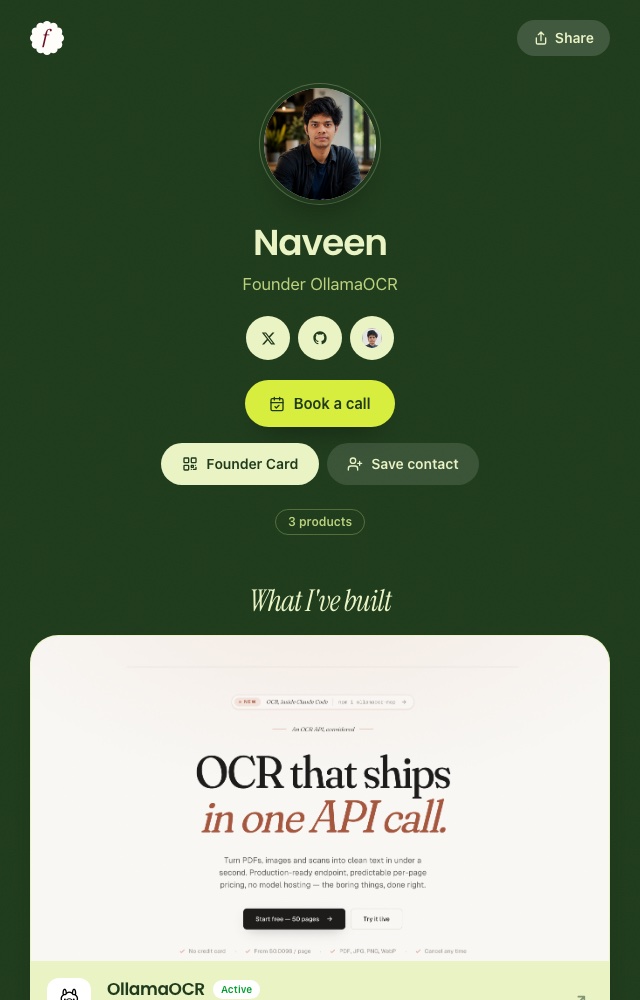
A personal branding website is a site about you, not a company: who you are, what you're known for, and the proof behind it. For founders, it's the page people land on after they hear your name on a podcast, see a launch or meet you at an event. Its job is to turn "who is this?" into "I should talk to them" in under a minute.
You don't need a big site to do that. You need a clear headline, real proof and one way to reach you. The quickest way to get all three is founders.page: a free personal brand page for founders that's live in about five minutes, with nothing to design. Claim your name →
Key takeaways
- A personal brand site answers three questions: who are you, why should I care, what do I do next?
- Proof beats adjectives. Products, numbers and links do more than "passionate, driven, visionary".
- One call to action. Email, a booking link or a newsletter.
- Own it. Social profiles can change or disappear; your site stays yours.
- It can be one page. Many of the best ones are.
Why founders need a personal brand website
People buy from, invest in and partner with people they trust. Before they do, they look you up. What they find is your personal brand, whether you designed it or not.
A personal site helps in a few concrete ways:
- It ranks for your name. When someone Googles you, you want a page you control near the top.
- It outlives your projects. Companies get sold or shut down. Your track record should stay in one place.
- It sets the context. On X you're your last tweet. On your site you're your best work.
- It's the link you share. One URL for your bio, email signature, slides and conference badge.
The seven sections of a personal branding website
| Section | What it does | Example |
|---|---|---|
| Headline | Says what you do in one line | "I build tools for freelance translators" |
| Photo | Makes you a real person | A clear, recent headshot |
| Short bio | Gives context in three sentences | Now, before, why |
| Proof | Shows you've done it | Products with status, revenue, users, exits |
| Social links | Where to follow you | X, LinkedIn, GitHub |
| Call to action | The one next step | Book a call, email, newsletter |
| Writing (optional) | Shows how you think | A blog, essays or a newsletter archive |
1. A headline that says what you do
Most personal sites fail here. "Entrepreneur. Builder. Coffee lover." tells a visitor nothing. Write what you do and for whom: "I build calm software for small clinics" or "Two-time founder, now building an API for invoices". Our founder bio examples have dozens of templates.
2. A real photo
A clear photo in natural light builds more trust than a logo. It also helps people recognise you at events.
3. A short bio
Three sentences: what you do now, what you did before, what you care about. Write in the first person; it reads warmer. Save the long version for an About page, if you need one at all.
4. Proof
This is the most important section and the one people skip. Show what you've built, with links: products, their status (live, acquired, shut down), and numbers if you're comfortable sharing them. A shut-down project still counts as proof that you ship. For SaaS founders, MRR is the number people look for.
This is exactly what founders.page was built around: every product gets its own card with status, revenue and users, so your track record does the talking.
5. Social links
Link to the two or three places you're actually active. A dead Instagram link hurts more than no link.
6. One call to action
Decide what you want visitors to do, and make that the most visible button. For founders, that's usually Book a call or email. More than one primary button and people pick none.
7. Writing, if you'll keep it up
A blog or newsletter is the strongest long-term personal brand asset, because every post is another way to be found. But a blog last updated in 2022 signals the opposite. If you won't write regularly, leave it out. Many founders build in public on X instead and link to it.