Personal Website Examples: 10 Founder Sites Worth Copying (2026)
Real personal website examples from founders like Pieter Levels, Marc Lou, Paul Graham and Sahil Lavingia, what each one does well, and how to make your own in an afternoon.
October 5, 2026 · 4 min read
The best founder personal websites do one thing well: in a few seconds, they tell a stranger who you are and what you've built. Below are nine real examples, what each does well, and what to steal from it. If you'd rather not build one, founders.page gives you the same structure in a few minutes, so it's first on the list.
The nine founder sites were checked on October 5, 2026.
Key takeaways
The best founder sites are short. Most fit on one screen.
Lead with what you've built, not your job history.
Numbers build trust. Revenue, readers and years count when you're comfortable sharing them.
One clear next step: subscribe, follow or book a call. Not five.
You don't need a custom build. A founder page or a one-page site does the job.
1. founders.page: the founder site you don't have to build
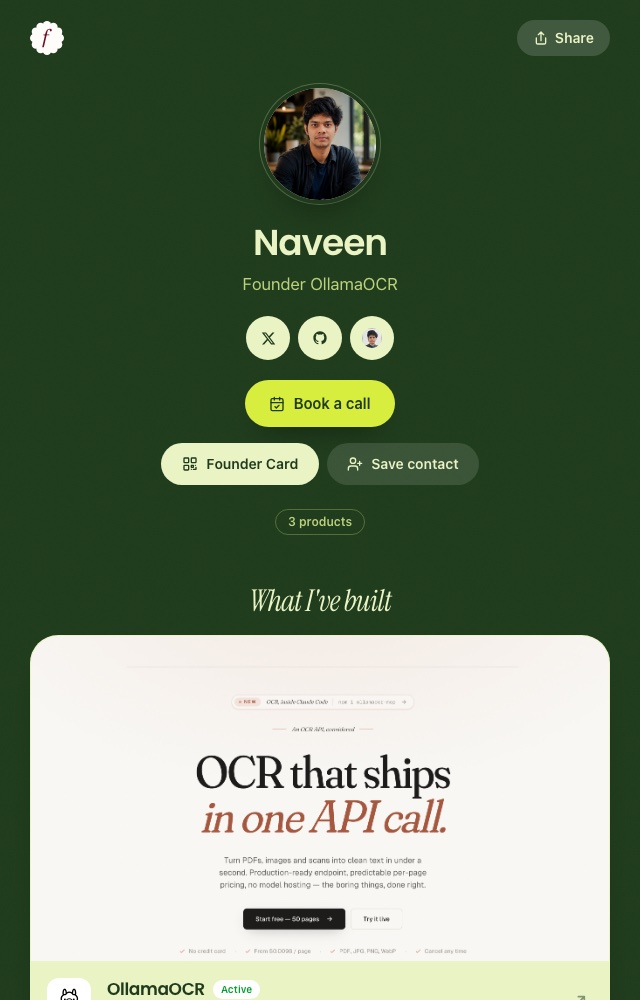
The best examples below share one shape: photo and one line, then what I've built, then how to reach me.founders.page gives you exactly that at founders.page/yourname:
Your photo, name and one-line tagline
Every product as a card with a screenshot, status (live, beta, acquired, sunset) and link, plus optional revenue and users, like Marc Lou's list
Socials, a Book a call button and your GitHub activity graph
A Founder Card QR people can scan at events to save you to their contacts
founders.page/naveenm: photo, one line, then what I've built.
It's free for the first 100 founders and takes a few minutes. Claim your name. If you own a domain, you can redirect it to your page.
2. Pieter Levels (levels.io): the product list is the bio
levels.io opens with "I build internet startups by myself" and names them straight away: Nomads.com, Remote OK, Hoodmaps, Photo AI and Interior AI. Then it says how many people read his posts by email.
Steal this: say what you do in one sentence, then prove it with names of real products.
3. Marc Lou (marclou.com): every product with its revenue
marclou.com is a list of startups, each with a one-line pitch and its monthly revenue next to it, under one headline: "I've built 36 startups solo."
Steal this: a product list with one line each is scannable. Revenue next to each product is optional, but it does a lot of convincing.
4. Danny Postma (dannypostma.com): one line and done
dannypostma.com is close to the shortest founder site you'll find: "Founder of HeadshotPro, a Singapore-based AI photography company", a few links and a subscribe button.
Steal this: if you have one main company, say it and stop. Short beats complete.
5. Arvid Kahl (arvidkahl.com): a site around one idea
Arvid's site is "The Bootstrapped Founder". Everything on arvidkahl.com, including the posts, books, newsletter and podcast, supports that one theme.
Steal this: if you write or teach, pick the one idea people should connect with your name.
6. Paul Graham (paulgraham.com): proof that design is optional
paulgraham.com has looked almost the same for decades: a column of essay titles. It's one of the most-read personal sites on the internet anyway.
Steal this: the content is the design. Don't put off publishing until the site looks perfect.
7. Patrick Collison (patrickcollison.com): a menu of what he cares about
patrickcollison.com is a short menu, with pages like Advice, Bookshelf, Fast, Progress and Questions. The site barely mentions Stripe. It shows how he thinks.
Steal this: a "what I'm interested in" page makes people want to talk to you, not just about your company.
8. Sahil Lavingia (sahillavingia.com): a great about me page
Gumroad's founder introduces himself in three words, "Founder Writer Painter", then lists his essays by year, from "Reflecting on My Failure to Build a Billion-Dollar Company" to newer pieces.
Steal this: if you're looking for about me page examples, this is the model: specific, honest and short.
9. Daniel Vassallo (dvassallo.com): products first, then everything else
dvassallo.com starts with Products (Small Bets, his books and courses), then the stories behind them, then where to find him.
Steal this: order the page by what you want people to do. Here, buying comes first.
10. Jack Friks (jackfriks.com): wins and failures together
jackfriks.com lists everything he's built, from Post Bridge to apps that went nowhere, followed by his record: 23 projects, 9 failures, 5 successes, about a 22% hit rate.
Steal this: showing failed projects makes the wins more believable, not less.
How to write your own in an afternoon
One sentence. "I build X for Y" or "Founder of X". If it needs a second sentence, cut something.
List what you've built. Name, one line and a link each. Include old and dead projects. They show you ship.
Add one proof point. Revenue, users, readers, years, or a well-known customer.
Pick one next step. Subscribe, follow or book a call.
Put the link everywhere. Your X bio, LinkedIn, email signature, pitch deck and GitHub profile.
Personal website ideas if you're stuck
A "now" page: what you're working on this month.
A numbers page: products shipped, revenue, users, the way Jack Friks counts his hit rate.
A timeline: launches, revenue milestones and exits by month. founders.page has this built in.
A "how I work" page: the tools you use, your hours, how to pitch you.
What should a founder's personal website include?+
Your name and photo, one sentence on what you do, the products you've built with links, a way to contact or follow you, and something that shows your thinking, such as posts or numbers. Most strong founder sites fit on one screen.
Do founders need a personal website?+
It helps. Investors, customers, journalists and possible hires search your name before they reply to you. A page you control decides what they find first, instead of an old LinkedIn profile or someone else's article.
How long does it take to build a personal website?+
A founder page on founders.page takes a few minutes. A one-page site on Carrd takes an afternoon. A custom site with a blog usually takes a weekend or more, plus ongoing upkeep.
What is a good about me page example?+
Sahil Lavingia's site is a good model: his name, three words for what he does (founder, writer, painter), and a list of his writing by year. It is short, specific and easy to scan.
Should I show revenue on my personal website?+
Only if you're comfortable with it. Marc Lou and Pieter Levels show revenue openly and it works as social proof for them. founders.page lets you show revenue and users per product, or leave them off.
Put your founder story in one link.
You, your products and your links, in a few minutes. Free for the first 100 founders.