What building in public means, why founders do it, what to share (and what not to), post ideas you can use this week, and where to keep your progress in one place.
October 15, 2026 · 5 min read
Building in public means sharing the process of building your product openly while you build it: what you shipped this week, what you learned, your numbers, and your mistakes. Instead of working quietly and announcing a finished product, you bring people along, so by launch day you already have an audience that cares.
This guide covers why founders do it, what to share, a list of post ideas, and the mistakes to avoid.
Key takeaways
Building in public turns your work into content, feedback and distribution at the same time.
Share progress, numbers, lessons and decisions. Keep customer data, secrets and anything you'd regret private.
Consistency beats volume: one honest weekly update is enough.
Keep a single page with all your products and milestones, such as a free founders.page, so new followers can catch up.
Why founders build in public
Distribution before launch. Every update is a chance for someone new to find you. People who watched you build are the most likely first users.
Faster feedback. Post a screenshot and you'll hear what's confusing within hours, not after launch.
Accountability. Saying "I'll ship X by Friday" in public makes Friday real. This matters most for solo founders, who don't have a co-founder to keep them honest.
Trust. Customers buy from people they've watched show up week after week.
Network. Other founders reply, share and introduce you. Some of the most useful relationships start in a reply thread.
What to share (and what not to)
Share
Think twice
Keep private
What you shipped this week
Exact revenue (your call)
Customer names and data without permission
Screenshots and demos
Pricing experiments while they run
Security details, credentials
User and signup numbers
Fundraising before it closes
Anything covered by an NDA
Lessons and mistakes
Complaints about specific people
Personal details of your team
Decisions and why you made them
Competitor comparisons
A good rule: share the process, protect the people.
Lessons
6. Something that didn't work and why.
7. The feature nobody used.
8. A pricing change and what happened.
9. The question every customer asks.
10. What I'd do differently if I started again.
Decisions
11. Why I chose this tech stack.
12. Why I'm not raising money (or why I am).
13. Two options I'm deciding between. Ask for votes.
14. What I'm saying no to this month.
15. How I prioritise the roadmap.
Milestones
16. First signup, first paying customer, first $100.
17. Launch day recap with real numbers.
18. One year of building: a timeline.
19. Hitting a goal you set in public.
20. Shutting something down, and what you learned.
Behind the scenes
21. My weekly routine.
22. The tools I pay for and what they cost.
23. A support ticket that taught me something.
24. My desk / setup.
25. A thank-you thread to early users.
Make it easy to catch up: one page for your progress
Building in public has a discovery problem. Someone sees one of your posts, gets curious, and clicks your profile. If all they find is a feed of 400 posts, they can't tell what you've built or how far you've come, and they leave.
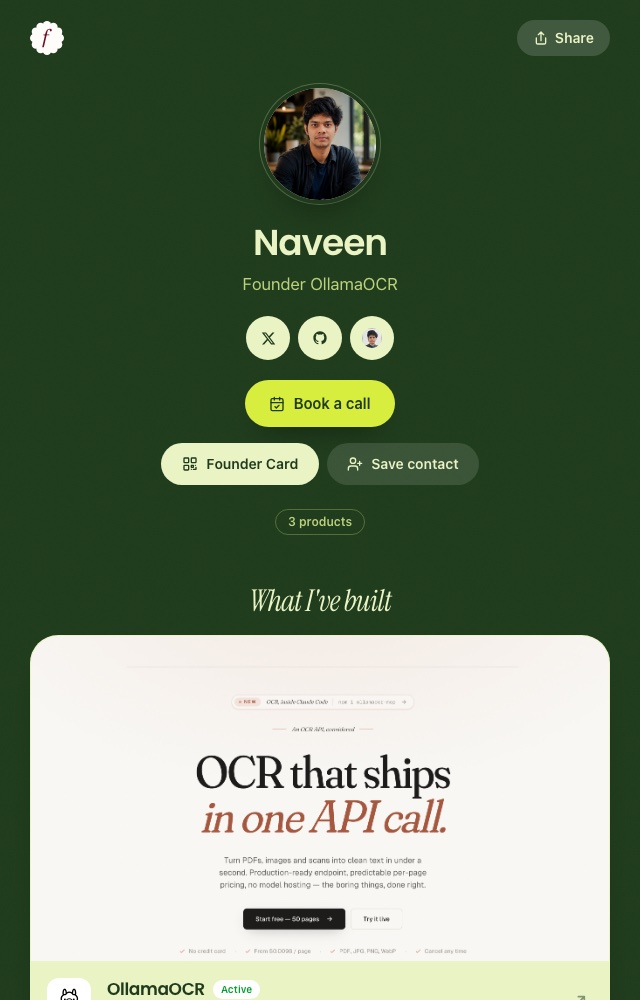
Give them a page that sums it up. On founders.page you can show:
Every product you've built, with its logo, link and status (active, beta, acquired or sunset).
Revenue and users next to each product if you share numbers. They're clearly labelled as self-reported.
A milestones timeline: first customer, launch, revenue goals, each with a date. It's your build-in-public story in one scroll.
Your GitHub activity graph if you code, which is about as public as building gets.
Your social links and a Book a call button.
Put the link in your X and LinkedIn bio, and every new follower gets the whole story in ten seconds. Create your free founders.page and add your first milestone today.
One page with every product and milestone, linked from your social bio.
Where to build in public
X (Twitter). The traditional home of build in public, popular with indie hackers and developers. Short updates and screenshots do well.
LinkedIn. Better if you sell to businesses. Longer posts with a lesson or a number work best.
A newsletter. Slower to grow, but you own the audience. Good for monthly recaps.
Communities. Indie Hackers, relevant subreddits and Discord servers, where detailed write-ups get thoughtful replies.
Your own page. The place every channel points back to.
Pick one main channel and one place to collect everything. Trying to post everywhere at once is the fastest way to stop.
A simple weekly routine
Monday: post your goal for the week.
During the week: share one or two screenshots or small wins as they happen.
Friday: a short recap. What shipped, what didn't, one lesson.
Monthly: a numbers update, and add any milestones to your page.
That's four to six posts a week with almost no extra work, because you're describing work you're already doing.
Common mistakes
Only posting wins. People follow the story, and a story needs setbacks. Honest posts about mistakes often do best.
Talking to other founders only. Founder audiences are supportive but rarely buy. Make sure some posts speak to your actual customers.
Vanity numbers. Followers and likes don't pay the bills. Share the numbers that show the business working.
Stopping after three weeks. The value compounds slowly. Keep it small enough that you can sustain it for a year.
No place to land. If a curious reader can't quickly see what you've built, you lose them.
Getting started today
Write your first post right now: what you're building, who it's for, and one goal for this month. Then set up your page so people who click through can see the rest. For more on presenting yourself, read how to write a founder bio, or see how others do it on Explore.
Frequently asked questions
What does build in public mean?+
Building in public means sharing the process of building your product or company openly as you go: what you shipped, what you learned, your numbers and your mistakes. Founders usually do it on X, LinkedIn, a newsletter or a public page.
Is building in public worth it?+
For most early founders, yes. It brings feedback, an audience that can become customers, and accountability. It is less useful if your customers aren't online, or if your competitive edge depends on secrecy.
Do I have to share my revenue to build in public?+
No. Revenue is popular because it is concrete, but you can share users, launches, experiments, lessons or behind-the-scenes work instead. Share only what you'd be comfortable with competitors and customers seeing.
How often should I post when building in public?+
Consistency matters more than volume. A short weekly or monthly update that you actually keep up beats daily posts that stop after two weeks. Many founders post small updates a few times a week and one bigger monthly recap.
Where should I build in public?+
Where your future customers already are. X is popular with developers and indie hackers, LinkedIn with B2B buyers, and a newsletter gives you an audience you own. Keep one page that collects your products and milestones so new followers can catch up quickly.
Put your founder story in one link.
You, your products and your links, in a few minutes. Free for the first 100 founders.