About Me Page Template: Ideas and Examples That Work
A copy-and-paste About Me page template, 10 ideas for what to include, and examples for founders, freelancers and developers. Plus the fastest way to publish one free.
October 15, 2026 · 5 min read
An About Me page tells a visitor who you are, what you do, who you do it for and how to reach you, ideally within the first screen. The template below covers those four jobs in order, and you can fill it in in about 20 minutes.
After the template you'll find ten ideas for sections worth adding, examples for different kinds of people, and the quickest way to publish the result.
Key takeaways
Open with one sentence that says what you do and for whom. Your story comes second.
Show proof: work you've shipped, results, dates. Visitors trust specifics.
End with one clear next step: email, book a call, or save your contact.
You don't need to design anything. A ready-made page like founders.page is enough for most people.
The About Me page template
Copy this, replace the brackets, and delete any section you don't need.
[Photo]

Hi, I'm [Name].
I [what you do] for [who you do it for].

WHAT I'M WORKING ON
Right now I'm building / doing [current project], which helps
[customer] [result]. [One proof point: users, revenue, clients, launch date.]

HOW I GOT HERE
[2–4 sentences. Where you started, the moment you noticed the problem
or found the work you love, and what you did about it.]

THINGS I'VE MADE
- [Project 1]: [one line on what it is and one result]
- [Project 2]: [one line]
- [Project 3]: [one line]

MILESTONES
- [Month Year]: [milestone]
- [Month Year]: [milestone]

OUTSIDE WORK
[One or two human details: where you live, a hobby, what you're reading.]

GET IN TOUCH
[Email] · [Book a call link] · [X / LinkedIn / GitHub]
The order matters. Most visitors decide in a few seconds whether a page is relevant to them, so the headline and current project go first, and the story goes after.
10 ideas for your About Me page
Not every page needs all of these. Pick the ones that support what you want visitors to do.
A real photo. A clear, friendly headshot makes the page feel like a person.
A one-line headline. "I build scheduling software for restaurants" beats "Welcome to my corner of the internet."
Your current focus. What you're working on this year, so people know what to talk to you about.
A short origin story. Why you do this work. Keep it to a paragraph.
Work you've shipped. Products, client projects, articles or open-source repos, each with one line of context.
Numbers, if you have them. Users, revenue, downloads, years of experience. One honest number does more than a paragraph.
A timeline of milestones. Dated entries ("Mar 2025: first paying customer") show momentum at a glance.
Social proof. A quote from a client or user, or logos of companies you've worked with.
Something personal. A hobby or a city. It gives people an easy opening line when they write to you.
One clear call to action. Email, a booking link or a "save my contact" button. Too many choices means no choice.
The quickest way to publish it (for founders)
If you're a founder or indie maker, most of the template above maps one-to-one onto founders.page, and you don't have to design or host anything:
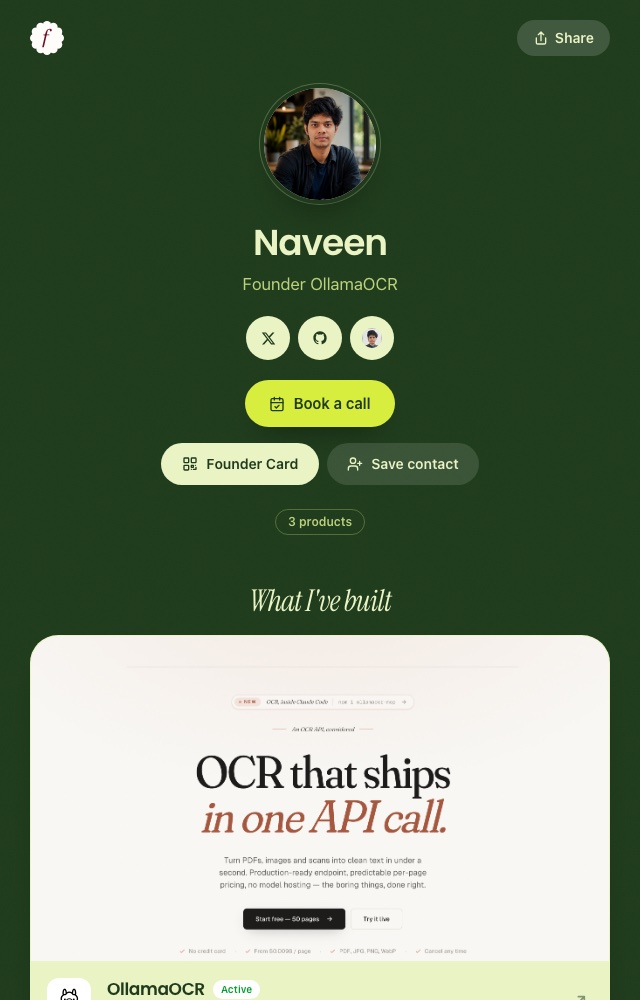
Headline and bio go at the top, next to your photo.
Things I've made become product cards, each with a logo, a link and (if you want) its revenue and users.
Milestones have their own dated timeline.
Get in touch becomes your social icons, a Book a call button for Cal.com or Calendly, and a Save contact button that adds you to someone's phone.
If you add your GitHub handle, a code activity graph appears automatically.
You get a clean link (founders.page/yourname) to put in your X bio, email signature and pitch deck. Create your free founders.page and paste in what you wrote from the template.
A founder's About page: bio, products, milestones and links on one page.
About Me page examples by type
Founder
Hi, I'm Maya. I build Shiftly, rota software that helps restaurant managers plan a week of shifts in ten minutes.
I ran a restaurant in Leeds for six years and spent every Sunday afternoon on spreadsheets. In 2024 I learned to code and built the tool I wanted. Shiftly now schedules 40,000 shifts a month.
Why it works: the first line names the product, the customer and the result. The story explains why she's credible.
Freelancer
I'm Tom, a freelance designer for B2B SaaS. I redesign onboarding flows so more trial users become paying customers.
Recent work: a new onboarding for an analytics startup (trial-to-paid up from 9% to 14%), and a design system for a fintech team of 12.
I'm booked through November. Email me for December.
Why it works: one specialism, two concrete results, and an honest availability note.
Developer
Hey, I'm Arjun. Backend engineer, mostly Go and Postgres. I like making slow things fast.
I maintain two small open-source libraries and write about database performance. Currently looking for a senior role at a small product team.
Why it works: it tells a recruiter exactly what he does and what he's looking for.
Student
I'm Sara, a third-year design student. I'm interested in accessible interfaces and spent last summer interning on a public-services website. Below are three projects from this year.
Why it works: it's short, honest about the stage she's at, and points straight to the work.
Mistakes to avoid
Starting with your life story. Lead with what you do now. History comes second.
Listing skills without proof. "Strong communicator" means nothing next to "wrote docs used by 2,000 developers".
Hiding contact details. If someone has to hunt for your email, they won't.
Letting it go stale. An About page that still mentions last year's job undermines everything else. Use a page that's quick to edit so you actually keep it current.
Too many calls to action. Pick one main action and make it obvious.
Next steps
Fill in the template above. Don't polish yet.
Cut it in half. The second draft is almost always better.
Publish it somewhere with a short, memorable link.
Put that link everywhere: social bios, email signature, conference badges.
At minimum: a photo, a one-sentence headline saying what you do and for whom, a short story of how you got here, proof (work, results or milestones), and a clear way to contact you. Everything else is optional.
How long should an About Me page be?+
Long enough to answer who you are, what you do and why someone should work with or follow you, which is usually 200 to 500 words. Put the most important line at the top, since many visitors read only the first screen.
Should an About Me page be written in first person?+
Yes, on your own site. First person sounds like a person rather than a press release and makes it easier to show personality. Keep a third-person version handy for event pages and press.
Where can I make a free About Me page?+
You can use a website builder's free plan, a GitHub Pages site if you code, or a ready-made personal page. founders.page gives founders a free page with a bio, every product they've built, milestones, links and a contact card, with no design work.
What is the difference between an About Me page and a portfolio?+
An About Me page is about you: your story, your values and how to reach you. A portfolio is about your work: projects, case studies and results. Many people combine them on one page, with the About section on top and the work below.
Put your founder story in one link.
You, your products and your links, in a few minutes. Free for the first 100 founders.